Lublin Info Centre
Lublin over 15 Years: progress, change, and growth
“We have 15 years of shared, dedicated work behind us that has transformed our city. Today, we can be proud of Lublin: strong in community, openness, and faith in the future. I wholeheartedly thank all the residents and my colleagues for this extraordinary time, for their trust, kindness, and daily support. Ahead of us lie new challenges and opportunities. I believe that together we will continue to shape Lublin into a city where life is good, modern, united, and welcoming. Serving as Mayor of Lublin is both an honour and a life mission for me.”
Record investment spending
In recent years, Lublin has invested over PLN 6 billion in more than 300 projects. European Union funding significantly supported major undertakings, with the city securing PLN 4 billion in co-financing. These funds enabled the transformation of the city in multiple areas: transport accessibility, quality of life, cultural and sporting offerings, and tourism.
Good transport has been a cornerstone of Lublin’s development since Krzysztof Żuk’s first term in 2010. Through a consistent investment strategy, the city expanded its road network, creating modern connections not only within Lublin but also with the rest of Poland and Europe. The Lublin bypass, realised after years of planning, significantly eased city traffic. Over the past 15 years, hundreds of kilometres of roads, pavements, and cycle paths have been constructed or renovated, improving residents’ daily travel and safety. Road investments alone have amounted to PLN 2.8 billion. Notable projects include the extensions of Dywizjonu 303, Mełgiewska, and Bohaterów Monte Cassino streets; the expansion of Solidarności Avenue to the bypass; the crossing at Żeglarska Street; a new bridge over the Bystrzyca River along with the extension of Muzyczna Street; and the extension of Węglarza Street. Aleja Racławickie has been renovated, and works on Aleja Unii Lubelskiej, including bridges, are ongoing.
Lublin Airport has opened the city to the world, boosting tourism and giving Lublin a strong advantage in attracting investors. Every year, hundreds of thousands of passengers use Lublin Airport. The Lublin Transport Hub has become a symbol of modern urban mobility: eco-friendly, functional, and fully integrated with other modes of transport. This central hub unites previous road and transport investments, serving as a showcase for the city and region. In addition, transfer points across the city connect car, bike, pedestrian, and public transport. The city’s largest European-funded project to date transformed public transport: new trolleybus lines were built, intersections upgraded, a depot established on Grygowa Street, and a modern traffic management system introduced. Comfortable buses and trolleybuses meeting the highest standards now operate in the city, making Lublin a leader in eco-friendly transport in Poland. The Lublin City Bike system operates successfully, and since 2021, passengers have used the Lubik electronic ticketing system. Travel in Lublin is now more convenient, faster, and environmentally friendly.
Public spaces and infrastructure
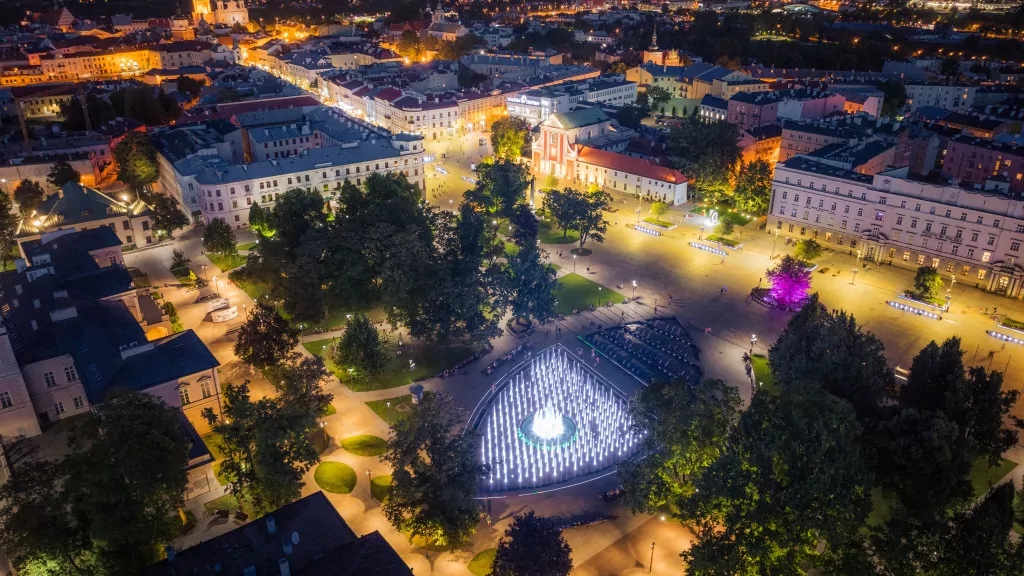
Recent years have also seen intensive development of public spaces. Plac Litewski and the city centre pedestrian zone, renovated and fitted with a multimedia fountain, have become key meeting points. Sporting, cultural, and social infrastructure has developed alongside. The city now boasts Aqua Lublin, a new ice rink, and the Motor Lublin football arena. The athletics stadium has been renovated, and work on the speedway stadium has recently begun. The reconstruction of the Old Theatre and modernisation of the Culture Centre have created new opportunities for artists and audiences. Plans are underway for the Children and Youth Art Centre. New care facilities have also been established: the “Kalina” Community Self-Help Home and Support Centre on Kalinowszczyzna Street; the Care and Housing Centre on Poturzyńska Street; emergency housing; and the Crisis Intervention Centre on Bronowicka Street is currently under construction.
Prioritising green spaces
Lublin has consistently increased its green areas, creating new parks, squares, green spaces, and rain gardens, while revitalising existing spaces. The city protects natural monuments and old-growth trees. Greenery has become an integral element of new urban investments, enhancing comfort and quality of life. Blue-green infrastructure is also being developed to mitigate climate change and support sustainable development.
City parks have undergone a significant transformation, becoming more welcoming, green, and vibrant. Saski Garden, Zawilcowa Park, and Ludowy Park now delight visitors year-round. Soon, Park Bronowicki and Błonia pod Zamkiem will join them. Modern parks offer cycling paths, walking routes, playgrounds, and recreational spaces, blending relaxation with activity. Over the past 15 years, the city has spent over PLN 178 million on green spaces, with more than PLN 7 million from the Green Budget.
Economy and employment
Lublin consistently ranks among Poland’s most attractive locations for investment. Focusing on priority sectors has attracted investors who create jobs and support innovative industries. A symbol of the city’s economic success is the Lublin Special Economic Zone subzone, fully developed with dozens of companies investing approximately PLN 3 billion, generating new employment for residents. The city also invests in business-supporting infrastructure, providing serviced land, building access roads, and increasing the availability of modern offices and conference facilities. From 2010–2025, grants to start businesses totalled PLN 125 million.
Education and academic life
Education is a key pillar of Lublin’s development, and the city invests consistently in modern facilities to improve learning and upbringing conditions. New schools, kindergartens, and nurseries are being built in growing districts. Notable investments include a modern school on Berylowej Street, the expansion of the school in Felin, and the ongoing construction of a new campus for Special Primary School No. 26, providing quality education for 300 children with disabilities. Existing facilities are modernised, sports infrastructure renovated, and energy efficiency upgrades carried out. Over the past 15 years, more than PLN 13.5 billion has been allocated to education.
Lublin is also one of Poland’s leading academic cities, with nine higher education institutions educating over 60,000 students, including around 9,000 from abroad. This internationalisation makes Lublin a truly global centre of science and education. The city supports cooperation between universities and business, fostering experience and career development. Joint programmes demonstrate that Lublin is a place where learning, innovation, and practice complement each other.
Caring for residents
Lublin prioritises the well-being of residents at every stage of life, including seniors, people with disabilities, and those needing additional support. New facilities provide care, rehabilitation, and daily assistance. The city operates Senior Clubs, modern support centres with day or round-the-clock services, including respite care, as well as health and activation programmes. From 2010–2025, over PLN 6.7 billion was spent on social policy.
Lublin is also among Poland’s safest cities. Safety includes hazard protection, barrier removal, infrastructure development, and fostering trust and care. Collaborative efforts by municipal services, community organisations, and residents ensure a secure and comfortable city.
Community participation and co-decision making
The strength of Lublin lies in its residents, who have a real influence on city development. Through participatory tools like the Civic Budget, District Plans, and Green Budget, they propose projects and investments. Participation involves dialogue, consultations, and advisory work. Cooperation with District Councils and NGOs is key, with joint initiatives such as Local Activity and Integration Spaces (MAL Szerokie, MAL Sławinek, Baobab, Spilno).
A landmark participatory process was the development of the Lublin 2030 Strategy under “Let’s Invent Lublin Together.” Over three years, thousands of residents shared ideas through workshops and meetings. Residents became co-authors of the city’s vision. District Plans emerged from dialogue with all 27 districts, resulting in hundreds of ideas shaping local strategies.
Sport and culture
Lublin thrives on sport and culture. Modern stadiums, halls, and pools host national and international events with thousands of spectators. The city supports Olympic athletes, nine teams compete at the highest levels, and 189 athletes represent Poland in Europe and worldwide. Lublin has become a recognised partner for major sports events. Youth sport is supported through training, access to facilities, and free city-based activities.
Cultural life flourishes, with new investments creating spaces for artists and residents. Events such as Noc Kultury and the Carnaval Sztukmistrzów have national and international recognition. The 700th-anniversary celebrations were a highlight. Lublin has been designated European Capital of Culture 2029 and, in 2023, Europe’s Youth Capital. Over 1,000 events during the celebrations strengthened the city’s reputation as youth-friendly, with a stable network of 10 Youth Spaces until 2030.
Open to the world
Lublin actively builds relations with 26 partner cities and 19 friendly cities, fostering cultural, academic, and economic exchanges. It participates in prestigious networks and hosts international events. Recognised as a “Rescue City” by Ukraine’s President, and awarded the Europe Prize and European Heritage Label, Lublin is a city of solidarity.
Tourism has reached record levels, with around two million visitors in 2024, including 428,000 international guests. The city offers cultural, sporting, and thematic attractions, supported by the Turystyczny Lublin app. Recognised as a “Polish Tourist Brand,” Lublin inspires, captivates, and invites repeat visits.
Lublin is also an important film hub. The Lublin Film Fund has supported dozens of productions with over PLN 5 million. The city has collaborated with renowned directors, from Andrzej Wajda to Filip Bajon, and hosted Oscar-winning scenes from Jesse Eisenberg’s True Pain.
Invest in Lublin